
Globally routable IP addresses are assigned and distributed by Regional Internet R>egistrars (RIRs) to Internet Service Providers (ISPs).
The ISP then allocates smaller IP blocks to their clients as required.
Virtually all internet users obtain their IP addresses from an ISP.
The 4 billion available IP addresses are administered by the Internet Assigned Numbers Authority (IANA).
IANA has divided this space into large subnets, usually /8 subnets with 16 million addresses each.
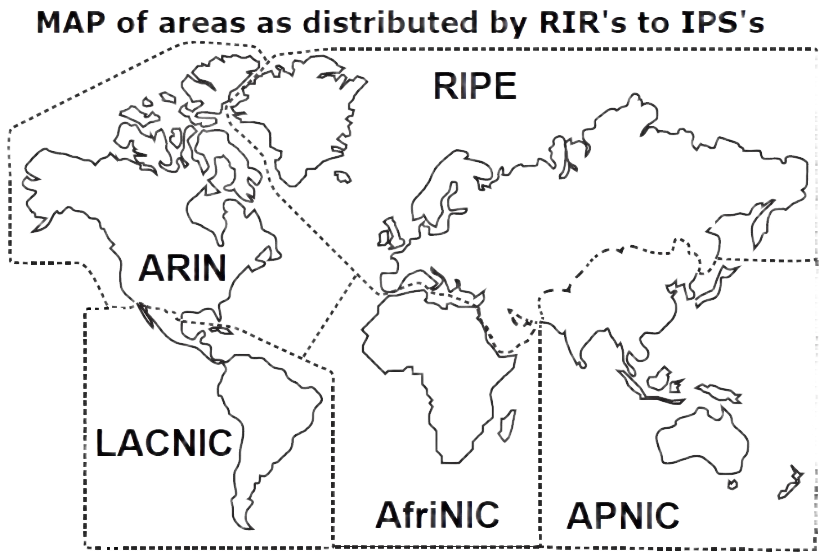
These subnets are delegated to one of the five regional Internet registries (RIRs), which are given authority over large geographic areas.
The five RIRs are:
| 1 | AfriNIC | African Network Information Centre | http://www.afrinic.net |
| 2 | APNIC | Asia Pacific Network Information Centre | https://www.apnic.net |
| 3 | ARIN | American Registry for Internet Numbers | https://www.arin.net |
| 4 | LACNIC | Regianal Latin-American and Caribbean IP Address Registry | https://www.lacnic.net |
| 5 | RIPE NCC | Reseaux IP Europeens | https://www.ripe.net |
Once IP address assignments have been agreed upon, it is possible to pass packets between networks and participate in the global Internet. The process of moving packets between networks is called routing.
A static IP address is an address assignment that never changes. Static IP addresses are important because servers using these addresses may have DNS mappings pointed towards them, and typically serve information to other machines (such as email services, web servers, etc.)
Blocks of static IP addresses may be assigned by your ISP, either by request or automatically depending on your means of connection to the Internet.
Dynamic IP addresses are assigned by an ISP for non-permanent nodes connecting to the Internet, such as a home computer which is on a dial-up connection.
Dynamic IP addresses can be assigned automatically using the Dynamic Host Configuration Protocol (DHCP), or the Point-to-Point Protocol (PPP), depending on the type of Internet connection.
A node using DHCP first requests an IP address assignment from the network, and automatically configures its network interface. IP addresses can be assigned randomly from a pool by your ISP, or might be assigned according to a policy.
IP addresses assigned by DHCP are valid for a specified time (called the lease time).
The node must renew the DHCP lease before the lease time expires.
Upon renewal, the node may receive the same IP address or a different one from the pool of available addresses.
Dynamic addresses are popular with Internet service providers, because it enables them to use fewer IP addresses than their total number of customers.
They only need an address for each customer who is active at any one time.
Globally routable IP addresses cost money, and some authorities that specialize in the assignment of addresses (such as RIPE, the European RIR) are very strict on IP address usage for ISP’s.
Assigning addresses dynamically allows ISPs to save money, and they will often charge extra to provide a static IP address to their customers.
Most private networks do not require the allocation of globally routable, public IP addresses for every computer in the organization.
In particular, computers which are not public servers do not need to be addressable from the public Internet.
Organizations typically use IP addresses from the private address space for machines on the internal network.
There are currently three blocks of private address space reserved by IANA:
10.0.0.0/8, 172.16.0.0/12, and 192.168.0.0/16.
These are defined in RFC1918.
These addresses are not intended to be routed on the Internet, and are typically unique only within an organization or group of organizations which choose to follow the same numbering scheme.